
About This Lesson
Copyright ASM International and The ASM Materials Education Foundation
Objectives for students
- To generate interest in types and properties of materials
- To help students develop their own definition/description of each material category
- Practice classifying and justifying (critical thinking)
- Students realize that science and classification aren’t always perfect
Materials for students
Bag of objects containing two or three each: metal, ceramic/glass, polymer and composite (one bag per team of four students)
- Table 1 Possible Properties and Descriptions of Each Category
- Table 2 Classification of Materials
- Table 3 Stuff: The Materials the World is Made Of
Procedure
Instructor Notes
- Collect the items and assemble the bags of objects ahead of time.
- Do not use the exact same items for each team.
- Use mostly simple, familiar items that can be found sitting around the classroom or home.
- Home improvement stores (Lowe’s, Home Depot, hardware stores) may be sources of composite materials. They often have scrap pieces. School athletic departments and youth sport organizations often have broken sporting equipment.
Following is a list of sample items:
- Metal: Copper wire, penny, nickel, dime, quarter, steel wool, fork, scoopula, nail, paperclip, aluminum foil, measuring cup, spoon, baseball bat, golf club head, etc.
- Ceramic/glass: Stirring rod, glass bottle, chalk, coffee cup, plate, test tube, calcite crystal, brick, tile, small clay flowerpot, etc.
- Polymer: preform, PVC pipe, rubber stopper, foam cup, plastic cup, wax (candle without wick), latex balloon, plastic fork, plastic measuring cup, acrylic cube, Tyvek (Fed Ex envelope), cotton cloth, plastic tubing, etc.
- Composite: Mylar balloon, cardboard, plywood, concrete, Hardi-board (HardiPlank) siding, Formica countertop sample, composite lumber (decking), fiberglass (from shower stall or hot tub), sporting equipment – broken shafts (hockey sticks, baseball bats, tennis rackets, golf shafts, skis, fishing poles), bone, laminate flooring, etc.
ASM MATERIALS CAMP®-Teachers Classroom Workbook
- It is helpful to have small jeweler’s loupes or magnifiers available for the students to make closer examinations of the objects.
- As a warm-up to the activity, involve the students in a discussion on how they would create a classification system for an everyday item such as shoes or breakfast foods. The students should realize that there is more than one way to classify a set of items.
- Make the final object each team classifies slightly more difficult. The level of dialogue and reasoning is typically much higher after the first round of reports.
- A list of objects (and the reason for using them) for the final round may include:
- Lightbulb: Students struggle to classify this object since it has both metal and glass components. A lightbulb is known as an assembly—it is not a single material. This helps introduce students to new vocabulary and also the idea of scale. Students often call the lightbulb a composite because it is made of more than one material. Composites are made of more than one material and the components can usually be observed at the macroscopic level. In composites the different materials work together synergistically to provide properties not available in each material by itself. In an assembly, different materials or components work together to perform an overall function —in the case of a lightbulb, to produce light. The individual materials or components may be connected but they each are performing their own function and are not combined together to improve their own properties.
– To help the students understand the difference between an assembly and a composite material give them the example of a car—it is made of many components and many materials—each serving their own function with the ultimate goal of locomotion. The goal of a materials engineer is to find the right material for the right application, considering properties and cost. - Silicon lump: Silicon is a metalloid. Emphasize its position on the periodic table between the metals and nonmetals. As such, it doesn’t fit into any of the four categories. Students often think it is a metal due to its luster and color. But silicon is brittle and not a good electrical conductor. Metal is the material category that students seem to have the most prior experience with and usually classify correctly in this activity. It is good to have a “metallic-looking” item that isn’t a metal to make them think a little deeper. Silicon helps to teach the students that no classification system is perfect or will work for every possible sample. An additional category could have been added such as “semiconductor” or “electronic material”—which does exist in the Materials Science world. Silicon allowed the modern computer age to happen and is a very important material.
– Both Educational Innovations and Flinn Scientific sell silicon lumps. - Foamed glass: This material is used to clean grills and stainless steel tanks or shave the “pills” off of sweaters. It is difficult to classify due to its low density. It has somewhat of ametallic luster and is brittle. The foam seems to have properties of metals, ceramics/glass and polymers all at the same time but doesn’t appear to be a composite (made of more than one material). It does belong in the ceramics/glass category. This will introduce students to foams. Polymer foams have been around for quite a while but Materials Scientists are now making foams out of metals and ceramics/glass as well.
- Fiberglass mat: Fiberglass is a trademarked composite (Owens Corning) made of very fine glass fibers and a polymer resin. Individual glass fibers without the polymer binder are interesting because of how flexible they are. People are familiar with glass being brittle and shattering upon impact. However, glass is very flexible when the fibers are extremely thin. This can be compared to a small, slim branch and a tree trunk. The students often want to classify these white fibers as a polymer due to their perceived low density and flexibility.
- Kevlar fibers: A polymer that students often classify correctly based on characteristics but do not identify what the material actually is. Students are amazed at how strong the fibers are under tension and are fascinated when they find out it is Kevlar. They have usually heard of Kevlar but have not seen it in person or handled it.
- Carbon fibers: Another material that students are interested in. Carbon fiber composites are used widely in sporting equipment in today’s society. The individual carbon fibers (not embedded in a polymer resin) are often not recognized by the students but they usually classify them as a polymer. Polymers are primarily defined as being compounds or mixtures of compounds. Carbon fibers are made of long chains or networks of carbon atoms and while not technically a compound they do fall into the polymer category because of the large carbon backbone.
– Kevlar fibers and carbon fibers are available from IASCO (Industrial Art Supply Company). It may be possible to get small samples from local companies that work with composite manufacturing or repair.
Teacher Actions
- Circulate among the groups asking questions while they work. Be encouraging but do not indicate if their classifications are correct or incorrect at that time.
- Encourage the students to use senses other than sight but do not allow them to use taste.
- Rephrase what the student says so they can hear their thoughts. Do not accept “because” as a reason; insist that they give more. Give them lead-in questions if they need help.
- If a student places an item into the polymer category and gives their reason as “because it isn’t a metal,” request more information. Ask, “How do you know it isn’t a metal?” Process of elimination is valid reasoning.
- The class description/list of properties generated at the end of the lab may be written on four large sheets of paper or poster board and taped to a wall. As the students work with the different material categories, the lists/descriptions may be modified with additions or corrections.
Possible properties and descriptions of each category:
Metals
- Made of metallic elements or mixtures of metallic elements known as alloys
- Have metallic bonding
- Tend to corrode
- Most have to be reduced from ore
Ceramics/Glass
- Composed of compounds or mixtures of compounds
- Metallic elements ionically bonded to nonmetallic elements: Oxides, carbides, nitrides, sulfides, carbonates, sulfates, etc. OR Metalloids (semimetals) covalently bonded to nonmetallic elements in a network solid such as glass
- Do not chemically corrode
- Raw materials are minerals found in the Earth or manmade inorganic compounds
Polymers
- Composed of long-chain molecules made of nonmetallic elements
- Natural polymers include: DNA, proteins, silk, cotton, latex rubber
- Synthetic polymers include: Plastics such as nylon, polyurethane, acrylic, PET (recycling code #1), HDPE (high density polyethylene resin) (recycling code #2)
- Carbon or silicon backbone covalently bonded to other nonmetals such as H, O, N, F, Cl, S
- Petroleum and natural gas are the source material for many synthetic plastics
- Some readily degrade (break down) and others do not
- Some soften or melt upon heating and can be recycled – these are called thermoplastics; others called thermosets cannot be softened or melted with heat
Composites
- Combination of two or more materials that enhances their properties
- Properties depend on what materials are combined
- A common property combination sought is high strength with low weight such as fiberglass and carbon-fiber reinforced polymers (CFRP) used in sporting equipment
- The binder (matrix) can be polymer, ceramic or metal
- The reinforcement can be in the form of fibers, flakes, or particulates
- Some composites are laminates (layered) such as plywood or Formica countertops
- The components are often visible on a macroscopic scale (see them with the naked eye)
*Note that there are exceptions to the above classifications, such as silicon dioxide, considered a network covalent solid.
Student Actions
- Have students do a “free write” in their journal: List everything they k now about the four categories of materials including definitions/descriptions, properties, examples of the material, uses of the material, etc. (The four categories are metals, ceramics, polymers, and composites).
- Divide the students into teams of four and give each group one bag of objects to classify.
- Students separate the objects into the four categories. As a team, generate a list of properties or descriptions for each category and a percent confidence level. Each student is responsible for writing one list and giving a report to the class about that category.
- Give team reports to the class.
- Each team gets one additional item to classify.
- Go around the room and report again.
- Generate a class description or list of properties for each category of materials
- Fill out the Classification of Materials summary chart.
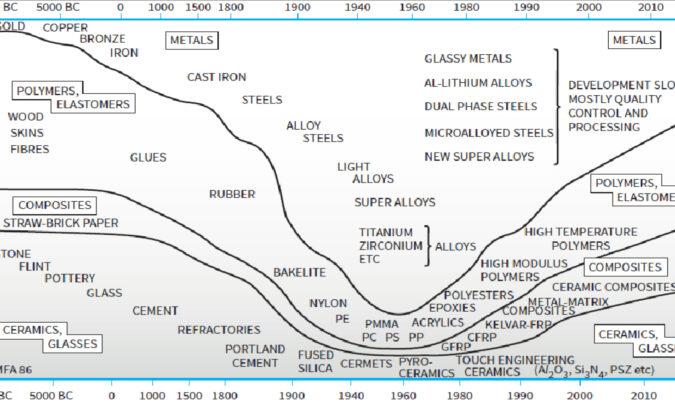
- Follow up with a discussion about the history of materials use.